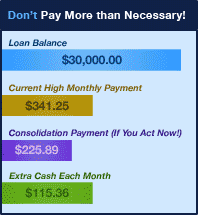
Don't pay extra money each month just because the government increased your interest rates--consolidate now before it's too late!
ED Commission Releases Draft
On June 26, the Commission on the Future of Higher Education published a copy—dubbed a "very rough"preliminary draft—of their final report.
The 27-page document addresses the areas of access, affordability, quality, innovation, and accountability of higher education in the United States. It admonishes U.S. colleges and universities in the areas where the commission determined that they fall dangerously short.
The report states, "Our year-long examination of the challenges facing higher education has brought us to the uneasy conclusion that the sector’s past attainments have led it to unseemly complacency about the future…Among the vast and varied institutions that make up U.S. higher education, we have found equal parts meritocracy and mediocrity."
The report states that because of poor preparation and inadequate financial resources, "too few of those who could benefit from college actually attend,"and "unacceptable numbers of college graduates enter the workforce without the skills employers say they need.”
The report also makes the troubling assertion that not enough information exists about the cost and quality of higher education, calling for strict "accountability mechanisms"for institutions.
After the preliminary draft circulated among commission members, it was greeted with concern and disapproval over its harsh tone. The topic is, according to commission chair Charles Miller, "complex and huge"and he went on to say that he was neither surprised nor troubled by the debate’s divisive tone. The commission is comprised of members from a wide variety of academic backgrounds.
The statement that "every person who can benefit from postsecondary education should have a place in college, and that it should be affordable"was countered with the argument that including the term "universal"implied that colleges did not have a right to set standards. Another debate centered on use of the word "unaffordable."The argument: How can a higher education be unaffordable when students are enrolling at American colleges and universities in record numbers? Is it price or insufficient preparation that is keeping students away?
The panel reached a tentative agreement on the idea of targeting financial aid to truly needy students and added that "need-based aid should be the dominant practice of financial aid programs and offices."This concept would deemphasize state lottery-based merit aid programs and also potentially to eliminate, or at least reduce, federal tax credits and loan subsidies for students who do not have significant financial need.
On the topic of infusing additional funding into higher education, it was stressed that any further monies should be provided only if colleges and universities can prove that they are doing a good job with what they already have been given.
The majority of agreement was reached on the idea that American schools must provide "significantly more and better information about their operations to a broad set of constituents, including students and parents, employers, policy makers, and the public."But there was a caveat: Schools are already wary of having to play a numbers game and teaching to tests rather than really educating students
When the commission convenes for its next session, it will continue discussions on meeting labor and work force needs and fostering innovation.
+ Consolidate Your Private or Federal Student Loans Now! (Save Thousands!!)
Up-to-date information is outdated information.
Get it up-to-the-minute from Law School Loans.
At Law School Loans, America's top law school lender, we employ some of the best financial advisers and finance journalists in the student lending industry. Be sure you're getting the most accurate data from the most trusted source, and stay up-to-the-minute on your own student loans!
Just use the RSS feed below and add this to any of the channels you use to receive blogs, podcasts, and other syndicated material.
Click here to sign up for our weekly Newswire now!
Free Ebook With All Registrations

My private loans had a 11.5% interest rate and I had called EdFed to see what they can do for me. The loan officer that I was working with started an application for me and ran my credit to see what my interest rate would be and its actually 8.6% I was so excited I faxed them my application that same day. Thank you for your help. - Kathryn B. Atlanta, GA
Your Federal Benefits
If you are still in-school, you may reserve your consolidation for graduation with Law School Loans. By signing and returning your application now, you will be guaranteed the current low rates on your consolidation, and you will not have to think about your consolidation again until you enter repayment.
Most federal loans are eligible for consolidation, including subsidized and unsubsidized Stafford, PLUS, Perkins, and other types of loans.
A few minutes on the phone or online could save you $600 a month or more on your student loan payments.
or Call (800) 659-8344
-CLICK HERE-to request an appointment with one of our expert loan counselors.