Law School Loans

Federal Loan Consolidation
Private Loan Consolidation
Bar Loans
Law School Tuition Loans
Government Relations
School Partnership Program
My Account
About us
Account Login
User Name:
Password:
Forgot your User name or Password?
New users: Register Today!
  Student Loan Consolidation Exclusively for Attorneys and Law Students
Determine How Much You Should Borrow

There are many hidden expenses when attending law school. Besides paying for the yearly tuition, students also have to pay for books, food, board, transportation, and many other living expenses. There is virtually no way to avoid borrowing money. However, budgeting your spending will allow you to borrow less.

Download PDF Tell Others
View Comments Post a Comment
When it comes to paying for law school, there are many things to consider. Yearly tuition is but one factor that will determine how much to borrow. Books, fees, room and board, and living expenses must also be accounted for. This is not an exhaustive list. There are many hidden expenses that should be added to your budget.

And that's the key word here: budget. It is crucial to plan a budget even before choosing which schools to apply to. Prospective law students must look at their options realistically. Sure, it would be nice to earn a law degree from Columbia University, but can you afford to live in New York for three years? It is possible with the help of lots of private loans. But those loans must be paid back, and the last thing anyone would want is a student loan debt twice his/her starting salary. Thus, it is important to factor in the average cost of living of the city where the law school is located. A lifestyle change will most likely be necessary. Just because you dine out four times a week does not mean you'll be doing so as a student. Having a $30 meal each week might seem like no big deal now, but over a semester, it will cost you $450. And trust me, that $450 will definitely come in handy down the road. Rather than buying coffee every morning, make coffee at home and bring a thermos to class. Penny-pinching as a student could potentially save you thousands in student loans.

The first step towards determining how much you should borrow is to list the financial resources you already have. This can include non-loan financial aid (such as grants and scholarships), income, savings, help from family and friends, and any other sources (say, the piggy bank you've had since third grade). Be sure to calculate your financial resources yearly. For example, your savings may only cover books for two years, while grandma is willing to write you a check every summer to cover rent. The more meticulous you are about the funds you have now, the less you'll have to borrow (and the less you'll owe).

Next, identify your expenses. This can be a daunting task, as you can't predict the future. Estimates are fine. But don't over-budget. Factor in only direct education expenses and living expenses. Examples of direct education expenses include tuition, fees, books, and supplies. Most, if not all, law school websites have a breakdown of the cost of attendance. You can also refer to the school's financial aid office for tips and advice on planning a budget. Examples of living expenses are mortgage or rent, utilities, food, transportation, insurance, entertainment, and personal expenses.

Once you have a rough estimate of the money coming in and the money going out, you'll be able to calculate how much you'll need to borrow. Once you determine how much you'll need to borrow, the first thing to do is look into federal loans. Federal loans have low interest rates and benefits such as interest subsidies. Federal loans can also be deferred while in school and have attractive repayment options. Plus, you can consolidate federal loans to get a fixed interest rate, which can save you money. Once you've exhausted your federal aid options, you can look into private loans. However, if a federal loan meets your financial needs, then do not be tempted to borrow more. The loans you take out should only be enough to cover the difference between the money coming in and the money going out.

To put all this into perspective, let's look at a case study:

Tom H. from Seattle, WA, has been accepted to Emory University School of Law and University of North Carolina at Chapel Hill School of Law. Here are his financial resources:
Income: $0.00
Savings: $5,000
Help from Family and Friends: $5,000 (per year)
Grants/Scholarships: $3,000 (per year)
The projected cost of attendance this upcoming year (including tuition, fees, rent, and books) for Emory Law is $50,062 and for UNC Law is $37,474. Tom's budget for personal expenses is approximately $3,000 (per nine-month school year). The breakdown is as follows:

UNC Emory
Cost:  $40,474 $53,062
Funds:  $9,600 $9,600
Loans:  $30,874 $43,462

As we can see, even using a conservative budget for living expenses, Tom must borrow tens of thousands of dollars each year. Federal Stafford Loans will cover $18,500 each year. If Tom borrows the maximum Perkins Loans each year ($6,000), he will still need to find about $6,500 in private loans each year should he choose to attend UNC or about $19,000 in private loans each year should he choose to attend Emory.

There is virtually no way to avoid borrowing (unless you receive a full scholarship or benevolent-and wealthy-Aunt Tiddy cuts you a check). But creating a budget will help you borrow less.


Article Title : Determine How Much You Should Borrow
Comment not found for this article.
Comment
 
+ Consolidate Your Private or Federal Student Loans Now! (Save Thousands!!)
Up-to-date information is outdated information.
Get it up-to-the-minute from Law School Loans.

At Law School Loans, America's top law school lender, we employ some of the best financial advisers and finance journalists in the student lending industry. Be sure you're getting the most accurate data from the most trusted source, and stay up-to-the-minute on your own student loans!

Just use the RSS feed below and add this to any of the channels you use to receive blogs, podcasts, and other syndicated material.

Click here to sign up for our weekly Newswire now!


Your Name: Your E-mail Address:

We respect your privacy.
Friend's name: E-mail address:
Include a Message:
+ Privacy Policy

Free Ebook With All Registrations

The customer service at Law School Loans is outstanding; definitely exceed my expectations of a student loan company. I was impressed with the attention given to me and my schedule. I had scheduled an appointment to speak with a Loan Consultant (first of all, unheard of in this industry). Something came up and I had to reschedule. So she set up a time that worked better fo...
- Andy L.  Boston, MA
5 Most Dangerous Trends of Student Loan Companies
Your Federal Benefits Law School Loans Guarantees Your Borrower Benefits

If you are still in-school, you may reserve your consolidation for graduation with Law School Loans. By signing and returning your application now, you will be guaranteed the current low rates on your consolidation, and you will not have to think about your consolidation again until you enter repayment.

Most federal loans are eligible for consolidation, including subsidized and unsubsidized Stafford, PLUS, Perkins, and other types of loans.
Newswire

Important interest rate changes, valuable new programs, and everything you need to know about your loans and repayment... sign up for breaking news updates from Law School Loans!
Email:

+ most recent newsletter
+ newswire archives
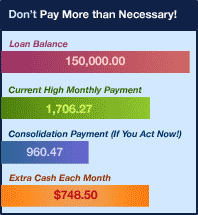
A few minutes on the phone or online could save you $600 a month or more on your student loan payments.
or
Call (800) 659-8344
-CLICK HERE- to request an appointment with one of our expert loan counselors.
Benefits of Federal Loan Consolidation with Law School Loans
Additional Information:
Repayment Options
Frequently Asked Questions
Retain Your Government Benefits
Why the Government Wants to Help You
About Us
Press Room
Glossary of Terms
What Will You Do With All The Extra Money Law School Loans Saves You???
Advice from Law School Loans:
Planning for Law School
Kennedy Introduces Legislation That Would Alter Federal Financial Aid

New Trend in Education Finance Counseling Programs

No Threat to Federal Student Loan Availability

Harvard Law School to Waive Tuition for 3Ls

Pennsylvania State University Switches to Direct Loan Program

Congress Urges Secretary of Education to Take FFELP Loan Action

ABA Releases Report on Law School Enrollment

Legislation Could Simplify Financial Aid Application Process

New Jersey Loan Guarantor and Attorney General Reach Settlement

Higher Education Act Renewed

Major Lender Exits FFEL Program

Investigations into Study-Abroad Programs

No Comprehensive Analysis of Cuts to FFEL Program, Secretary Says

Don't Look for Monsters

IRS Reminds Students of ''Tax-Advantaged Education Expenses''

Bush to Sign Conference Agreement

Borrowers Must Hurry to Receive Savings Before the October 1 Deadline!

California Students Get Relief, 2007-2008 State Budget Passed

Southern Illinois University President Accused of Plagiarism

Study Finds More Preparation Needed for Transition from High School to College

Wisconsin Students Awaiting Approval of WHEG Funding

Spellings announces $12 million in grants for tribally controlled schools

Four employees of Crown College under fire

Spellings Urges Colleges and Lenders to Comply with New Loan Rules

A New College Education Plan

Senator Herb Kohl introduces bill to help students remain out of debt

Study says academic tracking a major barrier to college attendance

Ithaka Advocates Online Publishing by Universities

Schools to Boycott U.S. News & World Report Survey

President Bush Threatens to Veto Appropriations Bill for Departments of Education, Labor, and Health and Human Services

Colleges to Start Policing Students Who Download Music

Virginia launches six-year plan to align K-12 standards with university-level education

Michigan tuition hike is daunting

College Admissions Are Still Beyond the Reach of the Economically Underprivileged

NASFAA Members Respond to Code of Conduct

New Hampshire University System Approves Tuition and Aid Increase

Free Tuition for Massachusetts Students: A Curse or a Blessing?

The Focus is Now on College Performance

U.S. Energy Department Going Greener

Senators Urge Spellings to Refrain from Imposing New Accreditation Regulations

Virginia’s James Madison University Approves Its Biggest Budget Yet

Massachussets Governor Proposes Free Attendance to Community Colleges

Federal Agents Raid Florida-Based Student Loan Company